5S Audit Software for Digital, Standards-Compliant Workplace Audits

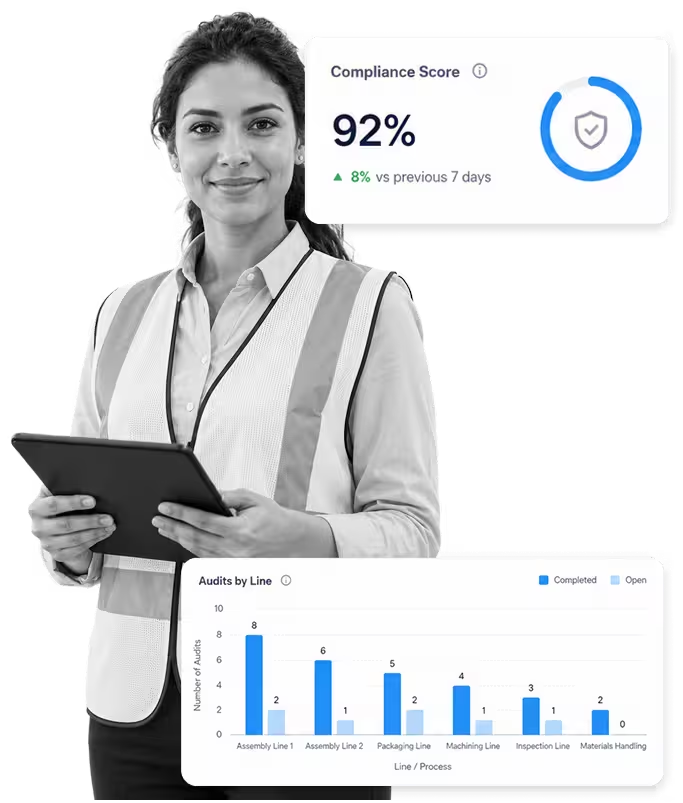
Missing tools and poor cleaning standards stall production and ruin lean audits. Stop losing data in paper checklists. flowdit Audit digitizes your 5S process instantly. Auto-calculate scores, attach shop floor photos, and assign corrective tasks in one tap - no more chasing teams or digging through Excel.
Watch the 2-Minute Demo

Transform manual organization checks into structured digital workflows. We guide your team through every step - from Sort to Sustain. Track and measure compliance across all your shifts and sites in a single platform.

Digitize audits to sustain compliance

Manual 5S audits fail because consistency is hard. Paper checklists vanish, auditors score subjectively, and finding follow-ups get ignored. flowdit Audit standardizes your scheduling, scoring, and corrections. Cut waste and build a culture of continuous improvement that actually sticks.

Meet strict lean manufacturing compliance standards

Centralize planning and evaluation

Ensure objective scoring across all sites

Fix vulnerabilities before they stall production
Audit planning and inspection
Planning workflow and strategy board

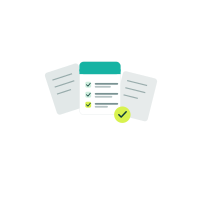
Centralize your 5S audit planning

Spreadsheets make tracking audit schedules a nightmare. flowdit Audit lets you schedule and manage all recurring checks from one dashboard. Automated reminders mean your team never misses an audit - and management sees completion status in real-time.

Control all tasks in one portal

Automate scheduling for recurring checks

Assign by shift, line, or specific auditor

Save 10+ hours a week with automated workflows
Digital checklist on tablet

Digital checklists for every "S"

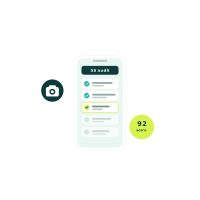
Stop guessing during inspections. Our app guides auditors through Sort, Set in Order, Shine, Standardize, and Sustain using smart conditional logic. Snap mandatory photos to prove compliance right on the shop floor. It even calculates your score automatically and works entirely offline.

Dedicated checklists for all five categories

Attach photo proof instantly

Auto-calculate scores without manual math

Audit completely offline - no Wi-Fi needed
Audit reporting dashboard

Generate compliant reports instantly

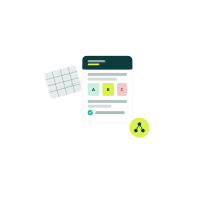
Stop formatting Excel reports manually. Our system applies your specific 5S weighting and scoring thresholds. As soon as an audit closes, you get a branded PDF ready for management review or compliance records.

Configure custom scoring models

Spot issues fast with color-coded results

Auto-generate branded PDF reports

Share securely via email or link
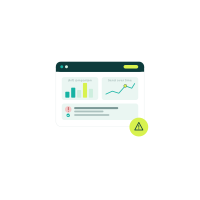
Audit analytics and KPIs

Analyze data to spot recurring failures

Raw data is useless without insights. Our embedded Power BI dashboards let you compare scores across different lines and shifts. Find the root causes of recurring issues and turn compliance into real operational growth, rather than just a check-the-box exercise.

Track KPIs by shift, area, and time

Pinpoint negative trends across sites

Measure ROI of corrective actions

Get set up fast by our expert team
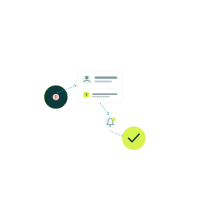
CAPA workflow collaboration

Close the loop on corrective actions

Logged issues often get forgotten. flowdit links every deviation to a specific corrective action (CAPA). Assign clear owners, set hard deadlines, and let automated reminders escalate overdue fixes. Verify completion so the same issue never fails your next audit.

Assign clear owners and deadlines

Send automated task notifications

Monitor resolution progress live

Verify fixes with built-in checks

Built for every workplace and industry

Consolidate your entire audit program. Our platform adapts to any environment, seamlessly integrating your 5S strategy alongside process audits, LPA, and daily safety checks.

Sort (Seiri) - Eliminate clutter

Set in Order (Seiton) - Organize perfectly

Shine (Seiso) - Maintain cleanliness

Standardize (Seiketsu) - Enforce rules

Sustain (Shitsuke) - Drive improvement

Take control of every step

Plan Audits
Schedules & templates
Execute
Offline mobile checklists
Document
Photos, notes & signatures
Score
Automated math & grading
Flag Issues
Log severity & root causes
Assign
Owners & strict deadlines
Report
Instant branded PDFs
Analyze
Live KPI dashboards

See how top teams use flowdit

Explore more stories

FAQs

5S is a lean method to organize workplaces by eliminating clutter, arranging materials logically, maintaining cleanliness, enforcing standards, and building continuous improvement. It reduces production waste, cuts safety hazards, and improves efficiency by making shop floors faster to navigate and easier to spot problems. Most manufacturers use 5S as the foundation for broader lean programs.

  • Sort (Seiri): Remove unnecessary items from the workspace.
  • Set in Order (Seiton): Arrange remaining items logically and label them.
  • Shine (Seiso): Clean and inspect the area thoroughly.
  • Standardize (Seiketsu): Create rules and procedures to maintain the first three S's.
  • Sustain (Shitsuke): Build discipline to make 5S a permanent habit across teams.

5S is one foundational tool within the broader lean manufacturing philosophy. Lean focuses on eliminating all waste across processes - time, materials, motion. 5S specifically addresses workplace organization and discipline. Most companies start with 5S to create a clean foundation, then layer on other lean tools like process audits, value stream mapping, and kaizen events.

Most 5S audits use a weighted scoring model where each of the five S's is assigned points based on compliance. Auditors evaluate criteria like "Are unnecessary items removed?" or "Are tools labeled and accessible?" and score each item on a scale (often 0-5 or 0-10). Total scores are calculated automatically using your defined thresholds, and results are color-coded - green for compliant, red for gaps. Digital audit platforms eliminate manual math and ensure consistency.

A complete checklist covers each S with specific, observable criteria: Sort - are broken or obsolete items removed? Set in Order - are high-use items in the easiest-to-reach positions? Shine - is the area visibly clean and well-lit? Standardize - are procedures posted and do staff know them? Sustain - are previous audit findings being tracked and closed? Photo attachments and notes capture evidence, and digital checklists guide auditors through conditional logic so nothing is missed.

Frequency depends on your industry and operational risk. Manufacturing floors typically audit weekly or bi-weekly to catch backsliding quickly. Offices or lower-risk areas may audit monthly. Newly implemented 5S programs often start weekly to build momentum, then shift to monthly or quarterly once discipline is established. Automated scheduling reminders ensure audits don't slip.

A typical 5S audit of a single production line or work area takes 20-45 minutes depending on size and complexity. Larger facilities with multiple lines may require 1-3 hours. Digital audits are faster than paper because the app auto-calculates scores and conditional logic skips irrelevant questions. With practice and familiar checklists, teams become quicker. Manual Excel-based scoring adds 30+ minutes per audit.

The most common failure is Sustain - standards slip because follow-up is weak. Fix this by assigning clear owners to each corrective action, setting hard deadlines, and tracking progress visibly. Paper audits get lost; digital systems send automated reminders and escalate overdue fixes. Another frequent gap is inconsistent scoring across auditors - solve with standardized checklists, photos as proof, and training on scoring thresholds.

Log each audit finding with the specific area, the S it belongs to, and severity. Create a CAPA (Corrective and Preventive Action) task for each issue, assign an owner with a clear deadline, and specify the exact fix - e.g., "Remove three broken jigs by Friday, Wednesday shift." Attach supporting photos. Send automated reminders to owners as deadlines near, and verify the fix during the next audit to confirm closure. Audit software links findings directly to action tracking.

Track labor time saved (auditors spend less time searching for tools or cleaning), scrap reduction, safety incidents prevented, and downtime avoided. Compare months before and after 5S implementation. A typical manufacturing facility reports 5-10% productivity gains and 20-30% fewer safety hazards within 6-12 months. Audit dashboards measure compliance trends across lines and shifts, helping you quantify the impact of corrective actions.

5S originated in manufacturing but is now standard across pharma, food & beverage, construction, logistics, hospitality, healthcare, and retail. Any operation with a physical workspace - warehouses, hospitals, kitchens, offices - benefits from 5S discipline. Food safety and pharma use 5S as part of GMP and compliance programs. Hospitals apply it to operating rooms, supply chains, and pharmacy areas to improve patient safety and efficiency.

Sustain means embedding 5S as a permanent habit, not a one-time cleanup. It's hardest because it requires ongoing discipline - every shift, every day. Teams drift back to old habits unless you reinforce standards with training, visual controls, audits, and peer accountability. Staff turnover introduces new people who don't know why 5S matters. Success depends on leadership modeling the discipline and celebrating wins visibly.

Yes. Digital audit apps work completely offline on mobile devices so auditors can inspect shop floors without Wi-Fi coverage. Photos and notes sync automatically once connectivity is restored. This eliminates the frustration of losing data or waiting for signals in warehouse or factory environments. Offline-first design is essential for real-time manufacturing environments.

6S adds a sixth step - Safety - to the original five. While 5S includes safety as part of cleanliness and organization, 6S explicitly prioritizes hazard prevention and injury risk. Some organizations adopt 6S in high-hazard industries like construction, pharma, or energy. Most manufacturers use 5S effectively by treating safety as integral to each stage.

Assign each audit location to a specific area owner - shift lead, supervisor, or line manager. That person is responsible for ensuring the audit happens and corrective actions are completed. Assign each finding to a specific owner with a deadline, not a team. Track who completes what and follow up visibly. Public dashboards showing completion rates create peer accountability. Recognize teams that maintain high scores consistently.

Ready to eliminate audit bottlenecks?

Skip the sales pitch. Tell us your biggest compliance headache, and we will provide an actionable plan within 24 hours.

Sales & demo requests
Mon-Fri, 9:00 am to 5:00 pm GST
+971 52 293 9955‬ support-int@flowdit.com
IOTIVATA - FZCO office in the Dubai Digital Park, Office A5-Dtec, Dubai Silicon Oasis